Categories
Uncategorized

Brand Name vs. Business Name vs. Domain Name

Your domain name is one of the vital factors that determine your brand success online. Wrongly chosen, it can tank other brand-building efforts, such as improving SEO or customer experience. However, making the right choice isn’t as easy as it seems. Most experts recommend matching your brand or business name to your domain name. While this works, there are several factors to consider — the availability of the business domain name, brand-ability, memorability, etc.

You’ve decided to expand your business online or probably just came up with an amazing business idea. Excitedly, you rush online to register your domain using your initial business or brand name, only to find out it’s already taken by someone else.

We get it. Nothing can be more frustrating than building a brand from scratch only to discover someone else using your identity online. Global brands such as Netflix, Coca-Cola, Apple, and Ford (including your competitors, most likely) have consistent branding. So, it’s only natural that you want the same for your business.

So, what can you do if your business domain name is already taken? Is it really compulsory to use your business/brand name in your domain? If you’re having difficulties making the right choice, you’re in the right place!

In this article, you’ll learn the major differences between business, brand, and domain names and their unique use cases. You’ll also learn how to align your brand or business name with your domain (even if they differ). Let’s get right to it!

What is a brand name?

A brand name is a unique name used to identify a company, product, or service. It is primarily for marketing and branding purposes since it establishes an emotional connection with customers.

Brand names are often used to communicate your business offerings to customers and help them understand why (and how) your business is relevant.

The best brand names are usually memorable, concise, meaningful, and scalable. It can be your name, e.g., Henry Ford, invented, e.g., YouTube, or an acronym, e.g., BMW, etc.

Next…

What is a business name?

A business name is the officially registered name of your company. It’s primarily for legal and regulatory purposes, as it acts as the legal identifier of your business. The name appears on your legal documents like Government forms, invoices, contracts, etc.

Your business name can be your full name (if you operate as a sole proprietorship) or be unique (if you operate as a Limited Liability Company). It helps to clarify your business purpose and differentiate your brands, especially  if you sell a variety of products.

Just like a good brand name, the right business name is easy to spell, memorize, and pronounce. For example, Apple Company Inc., Alphabet Inc., etc.

Lastly…

What is a domain name?

A domain name is the digital address of your business. Think of your website as your house; users need your domain name (the address) to find you online.

Compared to a business and brand name, a domain name doesn’t necessarily have to be used for legal purposes except if it matches them.

It directly impacts your SEO and how customers perceive your brand online. The best domain names are usually memorable, short, brandable, and scalable.

Should your domain name be different from your brand or business name?

There’s no one-size-fits-all answer to whether your domain name should differ from your business or brand name.

It can be entirely different or similar, depending on the availability of the domain, its brandability, memorability, etc.  

It’s popularly believed that your business name should align with your domain name. However, you’ll find here some globally-known companies whose business name is entirely different from the brand and domain names:  

Google

Domain name: google.com

Brand name: Google

Business name: Alphabet Inc.  

Facebook

Domain name: facebook.com

Brand name: Facebook 

Business name: Meta Platforms, Inc  

Mailchimp

Domain name: mailchimp.com

Brand name: Mailchimp

Business name: Rocket Science Group

So…

When should your business name and domain name match?

You have a well-known brand:

If you’ve already built a brand offline and are just looking to establish your online presence, it’s advisable to match your domain with your business/brand name.

This is because it:

  • Allows you to dominate the result pages for branded key phrases. For example, a user looking to order a McDonald’s burger will search for McDonald’s burger near me’
  • Makes it easier for your current and potential customers to find you online
  • Establishes and strengthens your brand credibility and authoritativeness online

Your business name is short:

If your business name is short, brandable, easy to spell, and passes the radio test, it’s the best choice for your domain name.

The best-performing domains are usually concise, memorable, and easy to spell and pronounce. This induces brand recall, fostering an enjoyable customer experience.

You intend to market your business as a whole:

If your business website serves as the major site for all your business offerings and is not focused on a specific product or service, then you should align your business name with your domain. This aids cohesion and makes it easy for users to find your brand online.  

You plan to expand in the future:

In addition, if you plan to expand your business offerings or increase the number of regions you’re targeting, having a coherent business name and domain name allows for a smoother transition. It also helps you avoid experiencing rebranding issues in the long-rub.

When should your business and domain name not match? 

Your business has several websites:

In a case where your business manages multiple websites, each with its own distinct product line, service, or brand, it might be strategic to have unique domain names that align with the branding of each site.

This allows for targeted marketing and helps customers easily differentiate between your business’s various facets.

Your business name is not brandable

If your business name is lengthy, hard to spell or pronounce, and contains foreign words, it’s better to opt for a different domain name.

For example, consider the business name ‘Marc Hollerith Edwards Printing Press LLC.’

While this is perfect for a business name, it’s too long and complex for a domain name. Users may not understand how to correctly spell Marc as it can be mistaken for Mark since they have the same pronunciation.

As we highlighted earlier, the best-performing domains are:

  • Succinct
  • Memorable
  • Short and easy to spell
  • Void of special characters

Therefore, choose a simpler, concise, and memorable domain to help your customers find you online without going through difficulties.

How important is matching your domain name with your business/brand name?

Having a consistent brand identity across all platforms (including offline) is essential for establishing a robust and memorable brand presence. It helps customers recognize your brand, reduces cognitive load, and makes it easier for them to find you online.

For instance, imagine a coffee shop named ‘Brew Haven.’

Customers who want to order online will likely type ‘brewhaven.com’ into the search bar. If this business maintains consistent branding online and offline, it’ll be easy for customers to find them and even recommend them to their network.

A coherent brand-domain name, therefore, facilitates brand recall, boosts customer experience, and establishes trust and loyalty.

Other benefits are:

Improved SEO and Online Visibility:

Aligning your domain name with your business name makes it easier for you to rank for branded keywords.

Using the example cited above, when your customers search for your brand online, they’re likely using search queries like ‘brew haven location’ or ‘brew haven coffee prices.’

If your brand name matches your domain name, search engines are more likely to recognize the relevance of your website to these queries, increasing your rankings on the search results.  

You can leverage this opportunity to rank for unbranded keywords like best coffee shop in Ohio, best coffee shop in the US, etc. This, in turn, boosts your website visibility and organic traffic.

Social Trust and Credibility:

Having a domain that mirrors your brand makes it easy for customers to share your services on their social pages or engage with your brand on social media. They are also more likely to trust your business for transactions, creating a positive user experience.

Let’s assume you run a plumbing service in Ohio called Job Plumbing Services.

When customers want to connect on social media or recommend your services, they’ll likely search for ‘Jobs Plumbing’ or ‘Jobs Plumbing Services.’

If you’re using a different name, for instance, ‘Plumber in Ohio,’ there might be a disconnection. Customers familiar with ‘Jobs Plumbing’ may not immediately recognize or associate the alternative with your brand. This affects your discoverability and social media credibility and raises suspicions in your customer’s mind.

Aligning your brand with your domain name fosters a recognizable, cohesive social media presence. It enhances your discoverability and builds your credibility on social media platforms.  

Improved user experience:

Aligning your domain name to your brand name doesn’t only improves your social credibility but also boosts user experience.

Users who search for you online intuitively expect to be directed to your website. If a different brand pops up for your specific name or experiences difficulty finding you, they might consider your competitors.

Lastly…

Scalability:

Do you plan to expand your business in the future?

If yes, having an aligned brand and domain name provides flexibility to expand your business to other regions since customers are already familiar with your brand.

Owning your business’s brand and domain name protects you from trademarks or legal issues in the new markets.

What should you do if your business name domain isn’t available?

Here are some tips to help you get started:

1. Register your business name using an alternative extension 

Whenever a domain name is taken, it’s usually the .com extension.

Luckily, there are several alternative top-level domains (TLDs), like .co, .net, .net, .biz, etc., to use. Though they don’t have a global appeal like the .com TLD, they still offer an excellent opportunity to retain your business name as your domain.  

You can be creative by combining your domain name with industry, e.g., ‘jobparker.plumbing, or location, e.g., ‘jobplumbing.ohio.’ Some TLDs are for reserved for specific purposes, e.g., .edu is strictly for educational sites.  

2. Modify the domain name.

If you insist on retaining the .com TLD, consider modifying your business name.

There are several ways to do this:

  • Adding a prefix or suffix to your business name to register for the .com extension. This can be adding ‘the’ to the beginning of your domain or your business location at the end of the domain. E.g., thejobplumbing.com or jobplumbingohio.com
  • Use hyphens to separate the words, for example, Merriam-Webster.com. However, this is not advisable and should only be used in extreme cases when other options are exhausted. If used at all, keep it to the barest minimum to prevent your customers from making mistakes when typing your name in the search bar.
  • If your name is too long or is native, consider using abbreviations or acronyms for your brand name. A good example is BMW (the full name is Bavarian Engine Works).
  • Use synonyms. E.g., if ‘ecosolutions.com’ is taken, it can be modified to ‘greensolutions.com.’ This retains the initial meaning of the name while offering the flexibility of owning the .com domain.

3. Contact the current owner

If you can’t find the right alternative, why don’t you buy the domain name?

Yes, it’s possible. Most domains that are taken may be currently inactive, which is a good opportunity for you to finally own it. Here’s how.

Firstly, visit the domain. You might see it’s up for sale from a listing page or hosting site. Or, you might get an error message that the site can’t be accessed.

If you experience any of these two scenarios, it indicates that the domain is up for grabs because the current owner is probably not using it.

Look up the domain on WHOIS.com to find all the information about the domain, including the webmaster’s contact details. In case the details are protected, you need to find the owner’s contact email address to negotiate the domain’s sale.

If you still can’t find it, contact a domain broker to help you reach the owner for inquiries, although this can be costly.

4. Include keywords

Adding keywords to your domain name not only presents an opportunity to retain your business domain name but also allows you to rank for your industry keywords.

In addition, it enhances user experience as customers will find it easy to understand what your business is all about.

This example from Benjamin Franklin Plumbing Services immediately tells users that the business is focused on delivering plumbing services only:

5. Use ccTLDs:

If you’re targeting a specific region, why not consider using the ccTLD of the country?

Country code TLDs (ccTLDs) may not be as popular as the .com TLD but help you retain your brand name and build relevance and credibility within the region. It shows specificity and commitment to serving customers within that area and provides an excellent opportunity for hyper-targeting localized marketing.

But before using a ccTLD domain extension, familiarize yourself with the local regulations to ensure you’re fully compliant. This prevents you from legal or regulatory issues that may eventually arise in the future.

Also, consider your target market. How do they perceive the domain extension? The .com domain, for instance, is more preferred in the US than the .us domain. But in Germany, users prefer the .de domain to the .com alternative. So, do your research before making a choice.

If all options are exhausted…

6. Consider expired domains:

Expired domains are the diamonds of the internet.

They have incredible ranking potential, high domain authority, and a robust online profile that can give you an unmatched competitive edge.

Why should you consider them?

If chosen right, expired domains can be your ticket to dominating the result pages in a fraction of the time it takes for a brand-new domain. They have built credibility and authoritativeness over time and, as a result, have a high rankability score.

Fortunately, you’ll find various keyword-related expired domains that help you stand out amidst the competition. So, instead of building or finding a new domain from scratch, you can leverage expired domains to skyrocket your success online.

Read more on how to choose the right expired domain for your business.

Conclusion

You don’t have to have it all figured out from the onset.

Facebook started as ‘thefacebook.com’ before acquiring the real ‘facebook.com’ domain.

List your choices and analyze them based on the strategies we recommended above.

However, if you opt for an expired domain, we’ve made things easier. We compiled a list of best-performing expired domains, ranking them based on vital metrics – page authority(PA), domain authority (DA), the archive birth year (ABY), price, and many more.


Categories
Uncategorized

The Psychology of Domain Name Length

Domain names are the address used to find a business online. Factors like brevity, brandability, memorability, and keyword inclusion determine a great domain name. Although a shorter domain is more beneficial, success can be attained with a longer domain name too.

When you decide to move your business online, one thing you cannot escape is the task of choosing a domain name. During this period, you will come across different opinions on the type of domain that will best suit your brand.

Because domain names contribute a lot to user experience, search engine optimization (SEO), and website performance, you’re caught between choosing a short catchy domain name or a longer domain that includes relevant keywords.

But then, ideal domain names aren’t exactly cheap or easy to come by, and before you go spending money on one, it would be nice to understand deeply, the impact domain name length has on your website’s performance.

In the rest of this piece, we will be looking at what makes a great domain, a head-to-head battle between long and short domains, and how domain name length affects SEO. but before then, here’s a reminder of what a domain name is.

What are Domain Names?

Domain names are unique and easy-to-remember web addresses that users type into a browser to locate your website. It is like an online equivalent of a physical address.

Just like owning a shop in the physical world, when the address is simple and memorable, customers will be able to find your business with ease. The same rule applies on the internet, hence the reason why domain names are so important in your bid to establish an online presence.

A domain name consists of the website name and a top-level domain (TLD) like .com, .org, or .net. For example, businessdomains.com is the domain name of this website. But then, what makes a domain name great? Let’s find out!

What Makes a Domain Name Great?

There are good domains and there are bad ones, but what makes a domain name special typically revolves around these things.

Brandable

Aside from being the address to your website, a domain name is the face of your business online. So when a domain name is catchy, simple, and memorable, users can easily remember and connect to your business. Over time, your domain becomes a brand in the niche you operate in.

A good example is apple.com, this isn’t a website about selling apples, but because the domain has become a brand, everyone knows they sell phones, tablets, e.t.c 

Pronounceable

Despite the fact most users type in a web address into a search engine, there has been a rise in people using AI assistants like Siri to carry out voice searches. Aside from this, when your domain name passes the radio test, it typically means it can be spelt correctly.

This reduces the chances of users misspelling your web address and ending up somewhere else. For example, cars.com can be easily pronounced, chances are, you won’t find anyone misspelling the domain name.

Brevity

When a domain name is simple and short, users can remember and memorize it easily. This helps to establish a connection and ultimately build trust between your website and the user.

Popular Top-Level-Domain (TLD)

Users find it easier to trust a domain name with a TLD they know. When you see a web address with a .com, .org, or .net, you feel a sense of security when you click. With trust comes more traffic and success.

Instantly Intuitive

A great domain name should be able to give the user an idea of what a website is all about. This helps drive only relevant traffic to your business. For instance, no one needs to tell you that travel.com is a website about the travel industry.

Includes Keywords

If a domain name contains a generic keyword to your industry, it could be ideal. But do not make the mistake of stuffing the web address with keywords, it will have the opposite effect on your website,

Google could flag it as spam and users are weary of keyword-stuffed domain names.

For example, GoDaddy.com looks more professional and legitimate than BuyGoDaddyDomains.com.

No Legal Issues

A great domain shouldn’t be confused with another domain name or have any trademark infringements. Before you set about buying one, make sure to check the domain does not violate any brand’s trademark rights.

Now that we know what makes a great domain name, what is the ideal length of a domain name?

What is the Ideal Domain Name Length?

When it comes down to it, choosing a shorter domain is more advisable. Typically, we recommend a domain name that is between 6-14 characters in length. This doesn’t include the “https://www” or .com or .net part.

But the problem is that short and ideal domains are extremely difficult to find, and unless you’re willing to spend big, you might not get a good domain name. This unfortunate scenario keeps pushing people further and further into choosing longer domain names.

What you don’t realise is that a long domain doesn’t affect your website negatively, neither does it result in a penalty for you. But where you take the significant hit is the overall user experience.

When your web address is too long, users find it difficult to memorize it, so unless your website is extremely useful to them, chances are they won’t remember it next time. Aside from that, users perceive a long domain name as unprofessional, spammy, and shady.

As of 2023, over 56% of all web traffic comes from mobile phones, and with many of those users typing and not looking, trying to type a long domain name isn’t a pleasant experience. You’ll find them looking for websites with shorter domain names to visit.

But before we rule out long domain names, let’s look at the pros and cons of both of them.

Benefits of Short Domain Names

Memorable

Because people tend to forget things easily, having a short catchy, and simple domain name can be a huge asset. By limiting your domain name to a few characters, users won’t find it easy to remember and locate your business online.

Mobile Friendly

With the majority of traffic coming from mobile phones, having a short and easy-to-type domain name can help your website benefit from this huge market. For instance, a user searching for football-related news will find it easy to search goal.com on his mobile device.

Marketable

When users see your domain name, they should be able to figure out what your brand represents. Because short domains are usually catchy and simple, they easily create a sense of connection to your business that ultimately becomes the face of your brand.

For example, Nike.com is a short domain name that today has become a big footwear brand.

Easily Shared

In practical situations, shorter domains can be easily shared either through word of mouth, sharing links, or being embedded in posts. They look neater, more professional, and trustworthy.

Should you decide to print out cards with your website on them, it won’t eat up all the space left for other relevant information.

But it’s not all smooth sailing for short domain names, let’s find out what the cons are.

Drawbacks of Short Domains

Availability

Because of the benefits they give, everyone is out there looking for them. So if you set out to find one, you may not get an ideal one, particularly the ones with popular TLDs.

Cost

Should you find one that’s available, you will have to outbid plenty of people who are also trying to buy the domain. This of course means it will cost you a lot of money, especially those with high commercial value. For example, the domain name cars.com sold for $872 million in 2014.

Clarity

When a domain name is too short, it might not reflect the true nature of a business which may end up confusing the user. For instance, some people make the mistake of using their acronyms as their domain names.

Unless your acronym is essentially your brand name (eg. NASA), chances are your customers will find it hard to locate you online.

SEO

Some short domain names tend to lack keywords, this can affect your SEO efforts as the search engines find it difficult to direct relevant traffic to your website. Now let’s turn our attention to long domain names.

Benefits of Long Domain Names

Descriptive

Longer domain names can immediately tell a user what your business is all about. This helps to ensure that only the relevant traffic finds its way to your website. For example, onlinevideoconverter.com explicitly tells you what the business is all about.

Availability

Because of less competition, longer domain names are more readily available compared to the shorter and more popular domains.

Cost

Their availability and low competition make them cheaper to acquire. You can get some for a few dollars while a whole lot of them are free.

Keyword Inclusion

Because of their length, these domain names can contain specific keywords that could be beneficial to your SEO efforts. But take note that you don’t stuff the domain name with keywords, this will have the opposite effect on what you’re trying to achieve.

Drawbacks of Long Domains

Memorability

When a domain name is too long, it becomes difficult for a user to memorize it. This increases the chances of misspelling the web address or forgetting it completely.

Typing Difficulty

A long domain name might be challenging to type correctly. With many people searching from their mobile phones, the chances of making errors are high. This leads to a poor user experience which negatively impacts the performance of your website.

Less Brandable

Long domains have lesser branding and marketing capabilities as compared to shorter, catchy domain names. So if you’re looking to make your business stand out, you’re better off with a shorter domain.

Perceived Unprofessionalism

Because they are cheap, unbrandable, and available, users see longer domains as spammy and low in quality. A shorter domain just has a feel of professionalism to it.

Now that we’re familiar with both short and long domain names, does the length of a domain affect SEO? Let’s find out.

Does Domain Name Length Affect SEO?

When it comes to SEO, the major factors Google considers are website content, relevance, backlinks, user experience, and mobile-friendliness among many factors.

This means with a well-optimized site with quality content, relevant keywords, and a good user experience, you can rank well irrespective of the length of your domain name.

However, the length of your domain name can have an indirect effect on SEO. For short domain names, their memorability, brand-ability, and keywords can help users type and remember web addresses accurately. This results in higher engagement and more visibility in search engines.

On the other hand, longer domains may contain relevant keywords which may make search engines rank a website high, or their perceived spammy nature might affect user trust and click-through rates.

So the question is, how do you go about choosing the most suitable domain name length for your business?

Choosing The Right Domain Name Length

The choice of length for a domain name ultimately boils down to what you’re trying to achieve, and how much you’re willing to pay for it. In an ideal world, your domain name should convey your business, and have relevant keywords, while being as short as possible.

But with how expensive short domains are, not everyone will be able to afford them. Does this mean you won’t get a domain name? We don’t see why you shouldn’t, there are a lot of long domain names that have been successful. A few examples are internetdownloadmanager.com, leaugueoflegends.com, and teacherspaysteachers.com.

Final Thoughts

Domain names are unique strings of letters that people use to locate a website online. Factors like brevity, memorability, brand-ability, and keyword inclusion are what make a domain name great.

We learned about the benefits and drawbacks of both long and short domains. We also learned that although domain name length is not a major factor in SEO performance, there are indirect ways it can improve or harm a website’s performance.

Although shorter domains possess more advantages, you can still achieve online success with a longer domain name.

Categories
Uncategorized

Domain Name Trends to Look Out For

New kinds of domains have started to emerge and as a business owner you should be able to adapt to stay relevant. Explore domain trends that you should look out for.

Your domain name is a critical part of your overall brand and most potential customers who are engaging with your business will consider your domain name as your brand name itself.

Hence, choosing a domain name that is memorable, catchy, and captures the essence of your brand is extremely important if you want customers to find you easily and remember you whenever they want to do business or buy what you’re selling.

However, the digital landscape and the internet itself are always evolving and business owners need to be able to adapt continuously to stay relevant and stand out to their target audience. Domain names too have not been left out.

With new technology like voice search and the blockchain, we are seeing webmasters starting to register new kinds of domain names and you should know them too whether you are a business owner or domain reseller. So let’s explore some domain name trends to look out for over the next decade!

The growing secondary market

The first and one of the most important trends that is definitely here to stay is the growing secondary domain market. We predict that preowned domains and expired domain sales will equal the number of new domain registrations. It’s only a matter of when.

The market for new domain name registrations has in some ways, flat-lined. In simpler words, most if not all domain names that are simple, short, and comprised of one or two actual dictionary words are already registered.

If you’re looking to buy a domain name that checks these boxes and is keyword-rich, you’ll have to buy one from a reseller or an expired domain. The point is that high-value domains that are available are very likely to have been used in the past.

But that’s not a bad thing. In fact, a domain that has been used in the past and has a good rep with search engines is far more valuable than a brand-new domain. Domain buyers realized this, and domain resellers appeared out of the void to meet that demand.

As a buyer, you’ll be looking to snag domains that have built a great rep with search engines, have high domain authority, have powered high-performing websites in the past, and the holy grail of domains – are currently generating traffic. As a domain reseller, you’ll be looking out for these qualities so you can build a high-value portfolio of domains that’ll always be in demand.

This trend will likely continue to grow and we don’t see it slowing down anytime soon. Preowned domain names are being sold on domain auction sites, and dedicated preowned domain lists like our platform, and buyers and sellers are also exchanging domains directly facilitated by escrow services.

Blockchain Domains

A new type of domain has been born – blockchain domains! Blockchain domains are hosted on a core blockchain network and unlike regular domains linked to IP addresses of websites, a blockchain domain can represent a wallet address, give access to blockchain apps, or also be tied to blockchain websites.

Cryptocurrencies, the Metaverse, and other concepts powered by blockchain technology are quite complex. These systems use cryptography to ensure security and uniqueness.

Addresses of cryptocurrency wallets and access keys to blockchain apps are complex and nearly impossible to memorize. A crypto wallet address contains a cryptographic sequence of alphanumeric elements – up to 42 for Ethereum addresses.

Blockchain domains provide an easy way to send money to crypto addresses, link to blockchain websites, and access blockchain-based apps by representing these complex cryptographic identifiers with much shorter, human-readable names that are far easier to remember and use.

Blockchain domains are also going to be truly owned by the registrant and once you make a one-time payment, you own them for life unless you transfer them out. This is one of the factors that makes them so appealing – regular domains are owned by the registry and you need to renew them… if you don’t renew them, they expire.

Also, you have full control over a blockchain domain – there’s no central authority or governing body like the ICANN with regular domains that determine how to use your domain.

Blockchain domains are also hosted across a network of nodes that power the blockchain so no governing body can restrict or block your access to the domain and you can use it for whatever you want to.

Emerging TLDs

Let’s face it – the .com domain extension or top-level domain is king. It is so widely accepted around the world that it will be a long time before any kind of TLD surpasses it.

However, recently new top-level domains and domain extensions have been emerging. Some popular ones include:

First, like from the previous point, blockchain domains! Blockchain domains feature unique TLDs and these will depend on the platform where the domain is hosted. Some popular blockchain TLDs include .bitcoin, .coin, .eth, .blockchain, .crypto, .dao, .nft, .wallet, .888, and several others. Some web browsers like Opera and Brave already support some of the blockchain TLDs.

Another popular pair of emerging TLDs are the .ai and .io TLDs. Initially, the .io TLD was intended for the British Indian Ocean area but in recent times, has become adopted by technological startups and tech companies. .ai domain extensions too have been on the rise, thanks to the rise of Artificial Intelligence (AI).

Domain name extensions that tell users what a business or website is about, or the industry it’s in have also been on the rise. For example, .blog, .tech, .developer, .design, .writer, etc. These generic top-level domains are making it easier for webmasters to find domain names that closely match what they want if the .com or .net domains are already taken.

Many online businesses are also now using country code top-level domains (ccTLDs) to better target local audiences. If you run a business catering to a particular region or area, a ccTLD can do you a whole lot of good and will be more trusted than a generic overarching TLD.

Voice-optimized domains

The age of voice search is close, thanks to Artificial Intelligence. We already have a good glimpse of what using voice for search will be like thanks to assistants like Alexa (from Amazon), Google Assistant, and Apple’s Siri.

The convenience of speaking into our phones and PCs rather than typing long queries is going to mean these searches will be more natural and conversational. Website owners and content creators will have to adapt and target more conversational, long-tail keywords in their content.

Domain name choices are beginning to change too. Today, exact-match domains don’t really boost SEO, but in the age of voice search, they’ll likely regain prominence. When a domain name is an exact match or is included in a voice query, it will have a higher chance of ranking well in voice search results.

It’s likely that a domain name closely matching a user’s voice query will indicate to voice engines that it is highly relevant to the query. The more specific a domain name is, the more likely the content it is linked to is also specific to that industry. With these new domain names, users will find more accurate results that answer the questions they are asking or provide the information they need.

Brandable domain names

A brandable domain name is a unique domain name that doesn’t necessarily describe what a business does but is associated with a particular brand or business. A brandable may or may not contain keywords that are relevant to your business or industry and your potential customers will need some more awareness to know what you ae about.

Think of it this way – with a brandable domain name, anyone who hears it pronounced will immediately think about your brand or business and not just your general industry.

Google (Google.com) is the most popular search engine in the world. The word ‘Google’ is not an actual word, but was made up to relate to something about indexing large amounts of data. Initially, they went with “googolplex,” then later “googol” and mistakenly typed “Google” when searching for the domain’s availability and stuck with this.

The word ‘Google’ at first glance, doesn’t suggest anything related to making searches or queries on the web. Domains like ‘Google.com’ are brandable domain names and are just used to refer to a particular brand or business and don’t necessarily describe what a business does or its core purpose.

A brandable domain name gives you a unique identifier to build your brand into.

Brandable domains are becoming incredibly popular especially since most keyword domains are already taken. With a brandable domain, you can get as creative as possible and there is almost an infinite number of brandable domains you can have compared to the limited keyword-rich domains.

A brandable domain helps you stand out and allows you to scale your business in the future to include new products or services without compromising or confusing potential customers. They are also less competitive and can turn into a household name.

If new domain name registrations will continue to surge, they will likely be from brandable domains.

On ExpiredDomains, we rank preowned domains according to our patented brandability score which gives you a good idea of how brandable a domain name is.

Domain privacy is becoming more prevalent

When registering a new domain name or buying a preowned domain, you will need to submit your personal details – name, address, phone number, email, etc. as required by the ICANN’s WHOIS policy. This ensures that owners of illegal websites can be traced.

The registrant data is also publicly available and anyone can run a WHOIS lookup on your domain to find your personal details. This is a double-edged sword as your data is exposed to bad actors.

Enter domain privacy – a service provided by most domain registrars where your personal details are replaced with proxy details that belong to the registrar itself so you are shielded. When you run a WHOIS lookup on a domain with domain privacy enabled, you’ll see these proxy details.

Many registrars offer domain privacy for free, but some premium packages will require you to pay a little extra fee to have it enabled on your domain.

Cybercrimes are on the rise as bad actors become more tactical, but on the bright side, more webmasters are becoming more aware too, and are employing domain privacy on their domains. In the near future, there’ll probably be no domain that doesn’t have domain privacy installed.

The only time you would need to disable your domain privacy is when you are transferring the domain out to a new registrar or transferring your domain to a new registrant.

Rounding Up

Domain names are essential for any individual or business that wants to have an online presence – and you definitely should if you want to reach as many customers as possible.

However, as new technologies emerge, the internet landscape as a whole is changing and domain name choices are also evolving to flow with the changes.

The secondary domain market is growing rapidly, blockchain domains are emerging and revolutionizing domain ownership and control, and new TLDs are being used for better marketing effectiveness. Voice search is also demanding exact match domains, brandable domains are on the rise, and domain privacy is now a must for every domain owner.

As a website owner or domain reseller, it is important that you monitor these domain trends and let them guide your domain choices when these emerging technologies become mainstream!

Categories
Uncategorized

Domain Brokers: What Are They and Why Do They Matter?

Domain brokers are mediators that ease the process of selling and acquiring domain names. They are an effective means to buy or sell valuable domains at the best price possible. Although they charge a commission, their expertise and industry connections are worth the fee.

When it comes to choosing a domain name, you will discover that the web address that best fits your business has most likely been taken by an individual or firm. This means trying to get it off them will require some form of research, negotiation, and sale.

But how do you go about this if you’ve never had the experience? How nice would it be to find someone who could just handle that, while you concentrate on running your company?

Luckily, there is a group of industry experts called domain brokers whose job is to facilitate the buying and selling of domain names. So in the rest of this piece, we will be looking at who domain brokers are, the pros and cons of using them, and an overview of some of the best domain brokers in the business. Let’s dig in!

Credits: Yahhya Anas

What is a Domain Broker?

A domain broker is an individual or firm that performs the role of a middleman in the buying and selling of domain names. Over the years, domain names have graduated from simple web addresses to business names and brands that could hold the key to online success.

Because of this, domain names have become a critical piece of online marketing and brand recognition, they have also shown the ability to rise in value over time. For instance, Cars.com sold for $872 million in 2014.

With the potential for a lot of money to be exchanged, domain brokers help in the search, valuation, negotiation, and sale of these domains. Typically, domain brokers are experts with years of experience and numerous connections in the domain industry. So what do they do?

How do Domain Brokers Work?

Purchase/Sale of Valuable Domains

Whether you’re trying to sell or buy a valuable domain, domain brokers make the process easier by doing all the paperwork and due diligence required for a smooth transaction.

Negotiation

Due to their vast experience in the domain industry, these brokers can effectively negotiate on your behalf. By doing so, you are positioned to get the best possible deal when you’re either trying to purchase or sell a domain name.

Facilitate Anonymous Transactions

When it comes to huge financial transactions, anonymity can be a great asset. Domain brokers can help you stay anonymous when you’re either trying to sell or buy a valuable domain name.

Appraisals and Valuations

Valuable domains usually command a high fee and how much they sell for could be influenced by many factors. Domain brokers are very good at appraising a domain name and determining its value. This way you won’t lose money or pay too much.

Host Domain Auctions

As experts and authorities in the domain industry, some of these domain brokers host auctions where interested parties can bid on valuable domain names up for sale.

Consultancy

Choosing a domain for your business could prove trickier than you might have anticipated. Domain brokers can use their wealth of experience to offer consultancy services when you’re trying to select the best fit for your business.

But then, you shouldn’t just engage the services of a domain broker from the get-go. These are some of the scenarios that would warrant getting a domain broker.

When To Use A Domain Broker

Complex Negotiations

Negotiations with a domain owner can be challenging especially if you’re unfamiliar with the market. In situations like this, it is wise to employ a domain broker’s expertise for an easier negotiating process.

Valuable Domains

Valuable domains usually cost a lot of money, and the key to either making a profit or paying the right price depends on accurate valuation and negotiation. Domain brokers can ensure a domain name is bought or sold for the right price.

Time Constraints

The process of buying and selling domain names can be time-consuming. So if you cannot patiently follow the procedure, it’s best you employ a domain broker to handle the task for you.

Confidentiality

If you prefer doing business anonymously, then getting a domain broker to buy or sell a domain name for you is perfect. Since the broker is negotiating on your behalf, your identity is completely left out of the picture.

Domain Portfolio Management

If you have an extensive portfolio of domains, you can engage the services of a domain broker to manage them on your behalf. This streamlines the selling or buying process which helps maximize profit.

But what if you don’t want to use a domain broker, what are the alternatives you can use to buy or sell a domain name? Let’s find out!

Alternatives to Domain Brokers

Credits: En Ndho

Direct Negotiation

If you don’t fancy paying a commission to a domain broker and you’ve got the time, skills, and understanding of the market, you can negotiate directly with a domain owner or buyer.

You can research the domain value and handle the transaction process yourself. The address and phone number of a domain owner can be found on the WHOIS database, so if you’re selling, make sure you’re accessible based on the information you put up there.

Escrow Services

When you agree on a fee with an interested buyer or seller, it is advisable to use an escrow service (link to piece) to ensure a secure transaction process. Escrow services ensure a smooth and fast transfer of ownership thereby eliminating the need for a domain broker.

Domain Marketplaces

There are a lot of online marketplaces that facilitate direct domain sales. You can easily check for available domains for purchase or put up yours for sale. This takes out the need for a domain broker and that pesky commission. Platforms like GoDaddy and Sedo are a good place to start.

Should you choose to hire a domain broker, what are the things you look out for to make sure they are the best option?

How to Choose The Best Domain Brokers- Factors to Consider

Performance History

In the domain industry, experience is key, so before engaging a domain broker, you need to check how well they’ve performed in the past. Take a look at the clients they’ve worked with before and how big the transactions were. If they were successful with those deals, chances are they will succeed with yours too.

Expertise With Domains

One of the reasons why you’re looking for a domain broker is because you want expert hands handling the transaction. You can know their level of expertise by checking previous transactions they’ve done or the company history.

Reviews

When an organization is good at something, people will talk about it. By checking reviews, you get a clearer understanding of how they handle transactions based on other people’s experiences. However, these firms will only post the best reviews on their websites, so you should consider checking third-party review sites for unbiased opinions on the broker.

Customer Service

Take time to ask the questions directly to the broker you’re considering. Most of them have round-the-clock customer service, and depending on how they respond, you will have an idea if they are reliable or trustworthy enough to do business with.

Terms and Conditions

Every domain broker has their unique terms of business, so before you get into any contract, you should read through it first. Usually, it will contain any charges that may apply or rules that may result in a cancellation of the contract. Do not skip any pages, every tiny detail matters.

Now that you’re aware of what to look out for when picking a domain broker, what are the advantages and drawbacks of using them?

Pros and Cons of Using Domain Brokers

Pros

Time-saving

Because the domain does all the documentation, prep, and legwork for you, it saves a lot of time that you would have spent trying to do things yourself.

Expertise

Most domain brokers are experts in the industry, and using them gives you access to people that will help you make better decisions when it comes to domains.

Industry connections

Domain brokers usually have a vast network of buyers and sellers, so using them plugs you into that network.

Stress-free negotiations

By negotiating on your behalf, they handle the back-and-forth of negotiations to get you the best deal possible.

Secure transactions

Domain brokers usually have a secure means of carrying out transactions. By using them, you worry less about possibly losing funds to scammers.

Anonymity

When you’re carrying out a big domain deal, it is in your best interest that news stays private. Domain brokers do the business on your behalf thereby preventing any release of transaction details to the public.

Accurate Appraisals

Due to their experience and expertise in the market, domain brokers can give you an accurate valuation of your domain or the domain you want to purchase. This could be the difference between making a profit or losing money.

With all these in mind, using domain brokers has its drawbacks. Let’s find out!

Cons

Costs

Because of the advantages they carry, using domain brokers comes at a cost. They usually charge commissions while some even charge an upfront fee before the service even begins.

Time Frame

When you engage a domain broker, the contract usually lasts for a certain period—mostly 30 days. If you’re not able to secure a purchase or sale by then, you will have to renew the contract which usually comes with a fee.

No Regulations

Domain brokers aren’t governed by any real market regulations, so they are free to conduct business without proper checks and balances. This is a scenario some might not be comfortable with.

Strict Terms and Conditions

Domain brokers usually have strict terms and conditions that must be adhered to. Some of them might stop you from selling your domain elsewhere during the period of the contract, while others only take up domains that are valued in thousands of dollars.

Then there are domain brokers that only agree to sell domains with a certain top-level domain (TLD). That’s why it’s important to read through the terms and conditions before going into a contract with any domain broker.

You can now make an informed decision on whether a domain broker is right for you. To make things easier, here are some of the best domain brokers in the business.

Who Are The Best Domain Brokers?

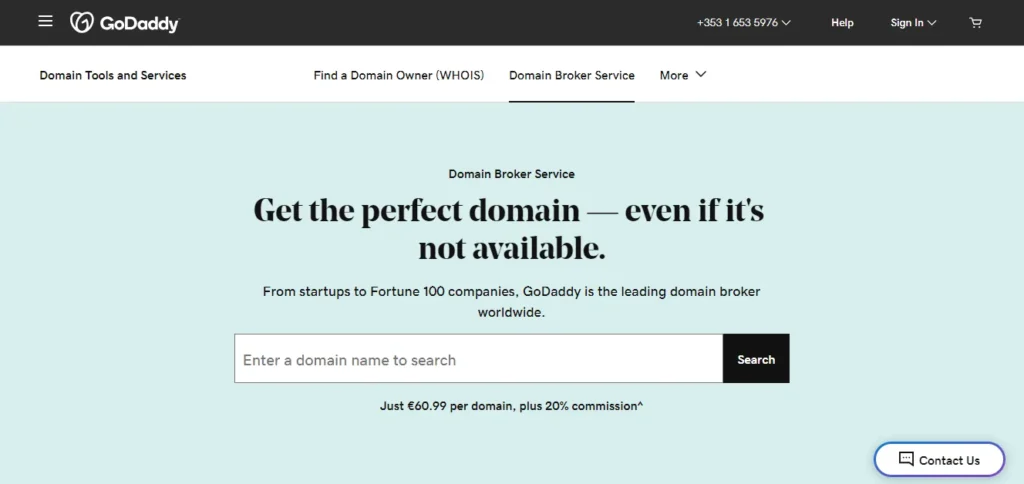
GoDaddy Domain Brokerage

Founded in Phoenix Arizona (1997), they are the ideal place for people who want to purchase domains but don’t want to blow through their budget. GoDaddy goes after domains for their clients irrespective of the cost. So if you don’t want to spend six figures on a domain, this is your best option.

They don’t broker sales but have an auction site you can use to sell a domain. They also offer a free domain appraisal tool.

However, they charge an upfront fee of $60.99 and a 20% commission if the deal goes through. Some of their past clients are Wolfpack.com, Merch.co, and iBuild.com.

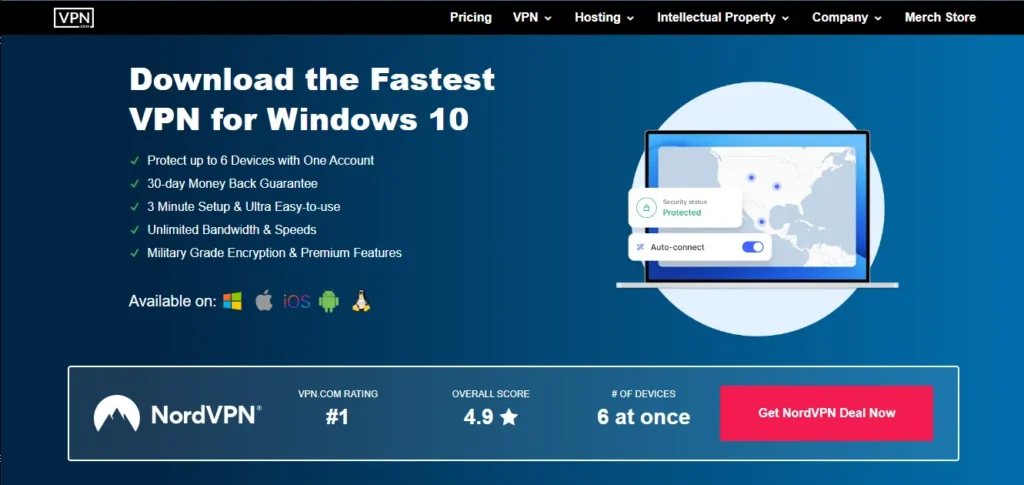
VPN.com

For those who love to remain anonymous, VPN.com can help broker the sale or purchase of a domain without disclosing your identity. Because of this, their clientele usually consists of wealthy individuals, large companies, and founders who would rather not disclose their identities.

They are also patronized by politicians, celebrities, and athletes for whom secrecy is of utmost importance. Aside from domain brokerage, they also provide virtual private networks (VPNs) for secure use of the internet.

They mostly take on clients willing to spend the big bucks, they don’t charge an upfront fee but will take a 15% commission when a deal goes through.

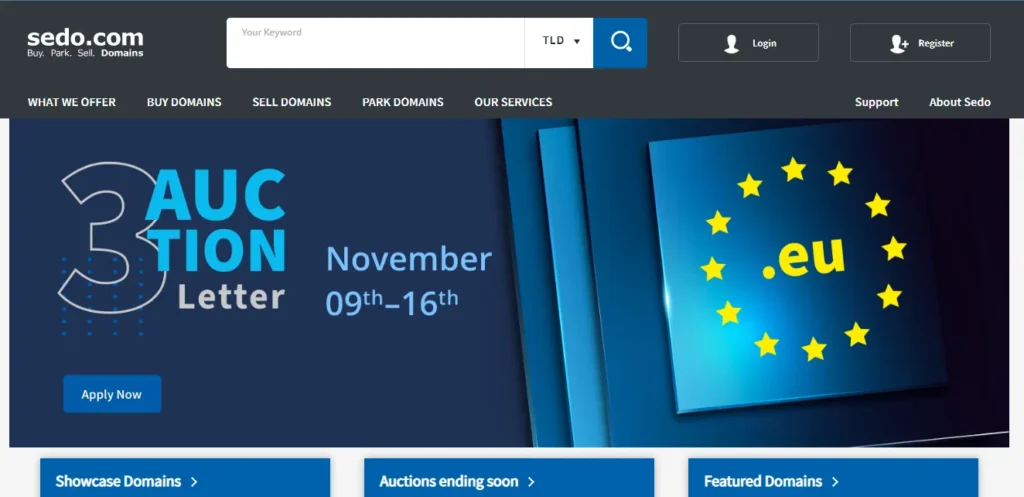
Sedo

Sedo is a domain name and website marketplace that was founded in 2001. Since their inception, they have made over 700,000 domain sales, and have over 2 million customers worldwide.

They can help you get appraisals, negotiate on your behalf, and transfer the domain name. The platform also allows you to buy, sell, auction, and park (keeping a domain currently not in use) domain names securely.

They do not charge an upfront fee but will take a 15% commission when the sale goes through. You can also park your domain for free and they will fix a price for it based on their expert appraisal.

However, they will charge a 10% commission should the parked domain be sold. Some notable websites brokered by Sedo are Call.com and Desktop.com.

Final Thoughts

Domain brokers are the agents that facilitate the sale and acquisition of domain names. Beyond that, they offer appraisal services and use their industry connections and expertise to make this process seamless.

We learned about how domain brokers work and the factors to consider when engaging them. We also learned about the advantages and disadvantages of domain brokers, and we then discovered some of the best brokers in the business.

Although they will charge a fee, buying or selling a domain name is a lot easier when backed with their expertise.

Categories
Uncategorized

Advantages and Benefits of Premium Domains

Premium domain names are the most valuable domains on the market. However, with their hefty price tags, you may be wondering if they are actually worth investing in. They absolutely are, if you know what to look for – and this piece shows you exactly how to go about buying a premium domain.

In the world of digital assets, premium domain names are the crème de la crème of domain names. Premium domain names are extremely valuable because they are memorable, catchy, short, and exceptionally marketable.
However, premium quality usually means stiff competition. Most premium domain names are either already registered by someone else who may or may not be looking to resell, or registrars who have marked these domains as ‘Premium’.
And what’s more? Premium quality means premium prices. Some premium domain names can go for between 5-7 figures. Now the question is – are premium domains worth it?
In the rest of this piece, we’ll discuss exactly what premium domains are, what makes a domain premium and stand out from a regular domain, the benefits of premium domains, where to find and buy a premium domain, and important considerations to make before you checkout. But first…

What is a domain?

A domain or domain name is the website address you type in a browser when you want to visit a website. For example: Amazon.com, Facebook.com, etc., are both domain names.
A domain name is basically the website name and is a crucial component that contributes to a website’s overall performance.

What are Premium Domains?

Premium domain names are domain names that are particularly catchy, short, memorable, relevant, keyword-rich, and unique. In the sea of generic domain names that are either too similar, unexciting, and just ‘one of the others’, premium domains make sure to stand out.
A premium domain’s value lies in its ability to resonate with a business’s audience, generate more clicks, and become a powerful brand that everyone associates with the particular business.
The best premium domain names are either extremely descriptive or so unique, that website visitors can’t help but connect emotionally with them. But what makes a premium domain ‘premium’ and how are they different from regular domains?
Let’s find out.

What Makes a Domain Premium?

They are easily memorable

Premium domain names are first of all, very memorable. A domain name that is easy to remember will generate far more visits than one user must always second-guess when spelling out.
Some of the factors that contribute to a domain name’s memorability are how short it is and how clear it is even just from the pronunciation. Premium domains are usually composed of short, real words that people use in everyday conversation – they are so easy, that not even a child will misspell them.
A premium domain name is also incredibly clear. They are easy to pronounce and are easy to spell by ear. The best measure of a domain’s clarity is the domain radio test. The radio test is simply a way to check how easily people can spell and find your website by just hearing it, without any prior knowledge of your brand.
Premium domains pass the radio test with flying colors and are easy to recall once a customer thinks of your brand.

They are short

We covered how premium domains are short above but we need to drive this point home. A premium domain very rarely contains more than one word in the main domain name and if it must include two words, usually includes them as the extension.
Single-word domains are quick and easy to type and therefore, ensure fewer visitors bouncing and more clicks and visits to your website or store.
Premium domains also tend to avoid unnatural word combinations with hyphens or underscores. Simple is the watchword. Finally, a premium domain will usually contain a maximum of two to four syllables.

They are easily brandable and unique

Brandable domains are domains that don’t necessarily describe what a business is about but make up for this with novelty and pure catchiness. These domains have the potential to turn into an incredible brand name and even become a household name.
Think of Google.com – ‘Google’ isn’t a real word but just sounds nice and catchy. Once you hear Google, the Google company and the popular search engine are what comes to mind. This is the power of brandable domains. They allow you to create a ‘niche of one’ and when users hear your domain name, they think only of you and not your industry in general.
Premium domains that aren’t keyword-rich, are incredibly brandable and ultra-unique. Their pronunciation and spelling stand out on their own and they may not necessarily be real words. Some premium domain names will combine a keyword or a variation of one to blend the best of both worlds – descriptiveness and uniqueness.

Keyword rich

While betting on a brandable premium domain can be a gamble, keyword-rich premium domains take no chances and guarantee that your customers will know exactly what your business is about even they visits and that’s why these domains get the most clicks.
A good example of a keyword-rich premium domain is Cars.com – no one needs to tell you what the website is about; everything about cars!
Most premium domains are valued for their keyword richness and may many times contain only the keyword itself. While the domain name isn’t a direct ranking factor on search engines like Google, if you were looking for generic information on cars, you are far more likely to click and remember cars.com than say another domain getcarinfo.io.
Cars.com looks and sounds incredibly trustworthy and there is something about brevity that speaks class and finesse, that appeals to people.

Highly relevant

As an extension of being descriptive, premium domain names are very relevant. Readers and visitors want to see the kind of content they are looking for and if what’s on your website is conflicting with your domain name, it can do more harm than good as people will begin to bounce.
A premium domain name that is descriptive will give users an idea of what they should expect even before they click. This will filter out your traffic to only highly relevant leads that are far more likely to engage and do business with you. And the more time they spend on your website, the better you perform in search.

They speak credibility – Trustworthy TLDs

A premium domain makes your business look credible and trustworthy. Premium domains also contain the most trusted top-level domains (TLDs) – the ‘.com’, ‘.net’, ‘.org’, and more recently the ‘.io’ TLD for tech-themed websites and companies, and these are what you will find in a premium domain.
By default, any user who hears of your business will assume the TLD is ‘.com’ or ‘.org’ when typing in your website address in a browser so it is important that the ‘.com’ TLD is what you go for. You can opt for the other two if the ‘.com’ is not available. The ‘.io’ TLD has become very popular recently in the tech community because it looks and sounds ‘geeky’.
Premium domains don’t contain TLDs like ‘.country’, ‘.xin’, ‘.gdn’, ‘.jetzt’, ‘.bid’, etc. because they just look and sound sketchy and can chase potential visitors off.

In excellent health

The best premium domain names, especially preowned domains, also have a healthy history. They have minimal or no history of penalities with search engines, excellent backlink profiles, good social media popularity, excellent ranking potential, and high search volumes, and have been around for a long while.

Benefits of a premium domain

Now we know how to spot a premium domain and some of its qualities, but how exactly can a premium domain help your website’s SEO and overall performance? Let’s see how:

Better SEO performance

Premium domains ensure better SEO performance and more time spent on your website thanks to their relevance. Premium domain names focused on relevance pull the best possible traffic – people who are interested in what you’re offering – to your website.
Poor quality visitors who are just browsing and may not necessarily be interested in your business won’t have to click as they know what to expect.
For example, a domain name called shoes.com is a premium domain that can have incredible pros for SEO if the website it’s hosted on is also about shoes.

Can generate more clicks

It’s a positive reinforcement cycle. The more people stay on your website, the better search engines figure out what your website is about and the kind of audience to show your web pages to for queries related to your industry.
With better context, your website will be served only to visitors who care about what your business is about and will consequently get more clicks. More clicks mean more conversions and more business for you!

Better marketability and value retainment

Premium domain names are far more marketable than regular domain names thanks to some of the elements we saw above. But even more importantly, if you are in the business of buying and reselling domains, premium domains retain their value forever.
A keyword-rich premium domain, in particular, will always remain relevant for as long as the industry or service it is describing remains relevant.

Where to Find Premium Domains

Now where to find a premium domain?

Registrars

Domain registrars are your first place to look when searching for a premium domain name.
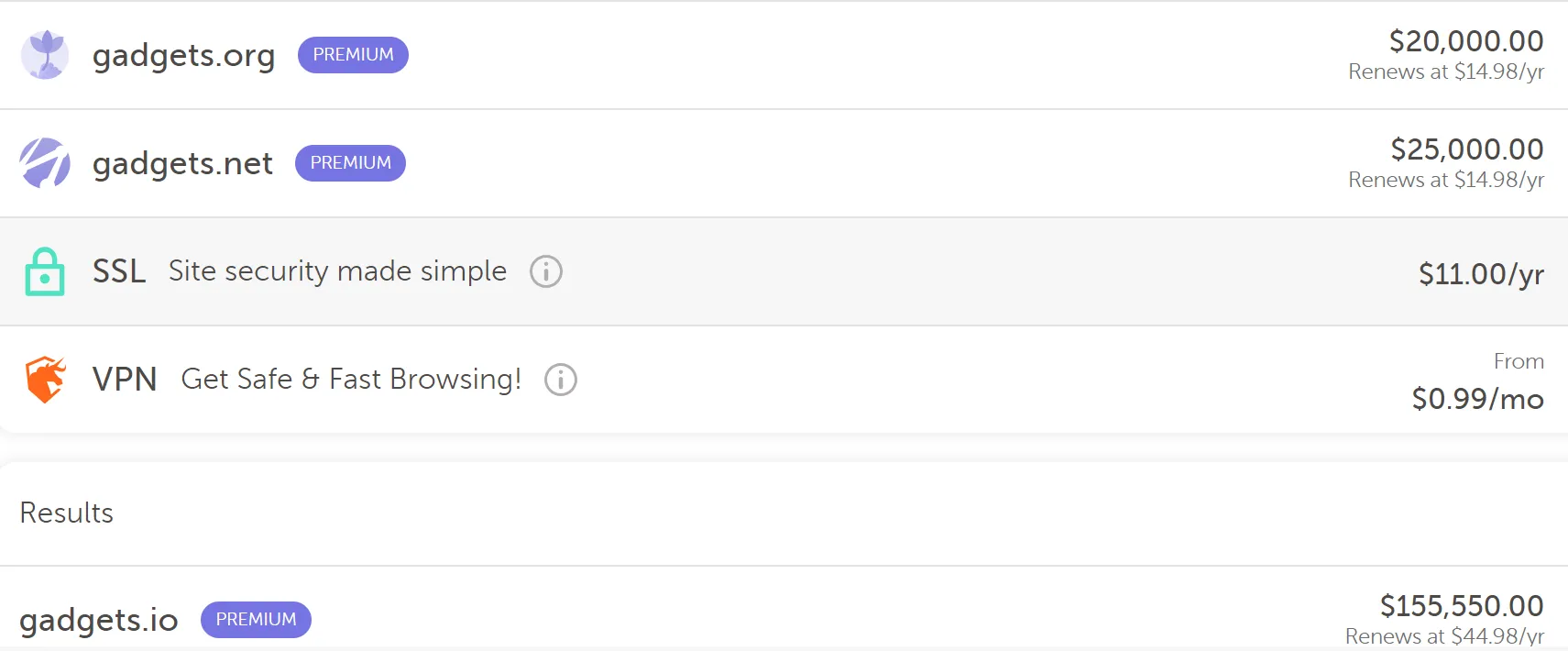
On these registries, you’d easily recognize them with a ‘premium’ badge or a star attached to them. While most premium .com domains will be taken, you can find closely matched variations, also trusted TLDs, tagged as premium domains.
Most premium domains that are not currently tied to a live website are owned by domain resellers looking to resell them for a profit and they will usually list their domains for sale on these platforms.
For example, the ‘gadgets.org’ premium domain in the photo above is only available for sale on a few registrars including Namecheap.

Auction sites

Domain auction sites are exactly what they sound like – marketplaces where people bid on domain names and then the highest bidder wins. Premium domain resellers flock to auction sites thanks to the promise of getting even more than what the domains are actually worth.
If you are looking to buy a premium domain, an auction site is an excellent place to find them but be careful with overbidding.

Domain listings

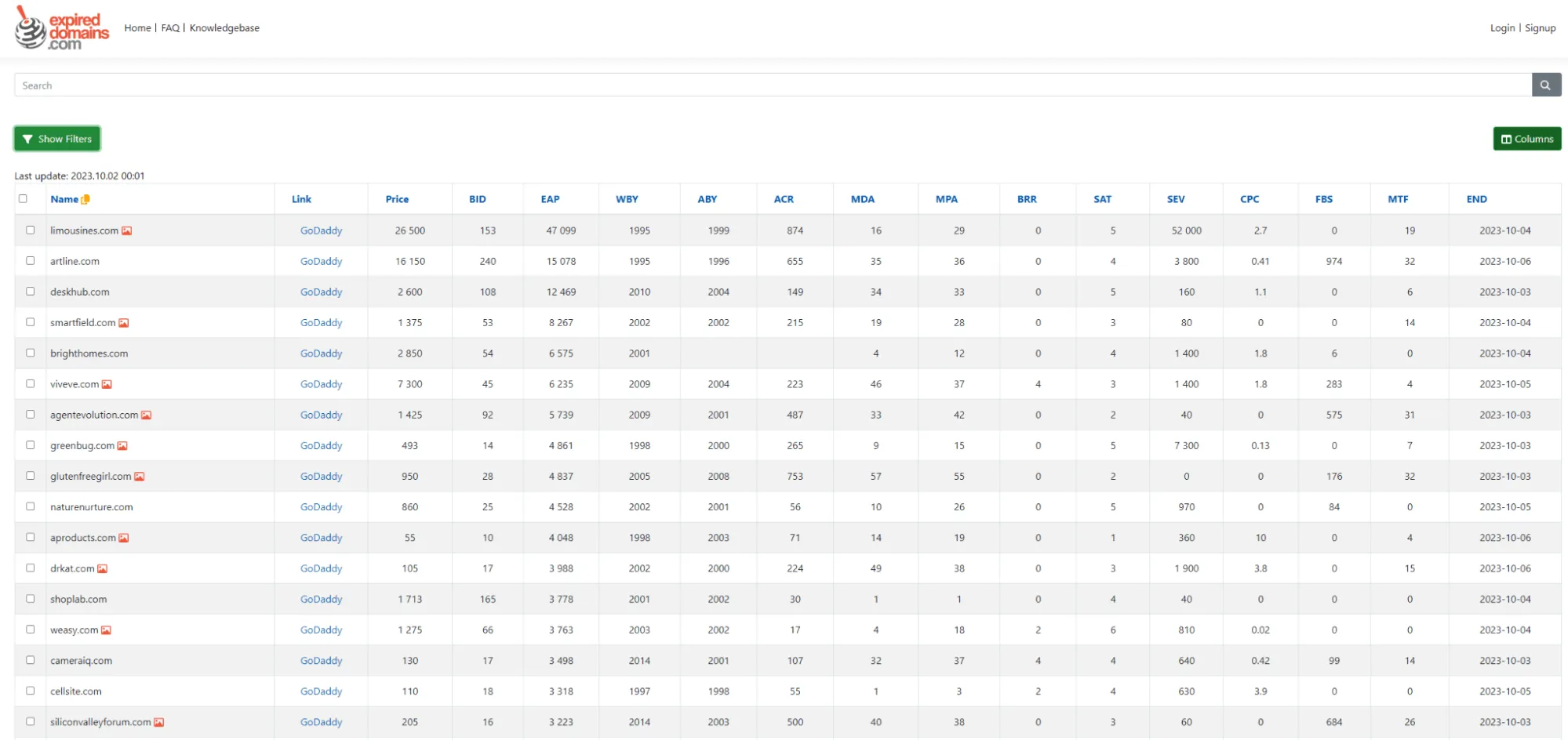
Domain directories and listings like expireddomains.com make it easy for you to find the best premium domains for the best prices possible. You have all the best domains, including the ultra-premium, brought to you.
Our list features links to the current auction pages for these domains, the number of bids, the current maximum bid price, and over a dozen other metrics. And the best part? You can filter the results to domains with a particular number of words, and brandability, based on the TLD – all the essential qualities that make up a premium domain!

Consulting a domain broker

Domain brokers or broker services deal exclusively with facilitating the sales of domains – especially pricier ones – to ensure you get the best deal possible. A domain broker will help you track the current owner of an already taken domain, make an offer, and negotiate a final price on your behalf.
Domain brokers will also conduct a market analysis to know the true value of a domain. If you choose to consult a domain broker, look for one with an impressive portfolio of high-profile deals and minimum commissions.

Buying a Premium domain name – factors to consider

Before buying a premium domain name, what are some boxes you should check?

Your budget

Premium domains are generally far pricier than regular domains so before you enter the market, make sure you have a budget in mind. So whether you decide to buy from a registrar or go the auction route, ensure to stick to your budget and dont overbid. And if you can’t find the exact domain within your budget, it may be worth it to look for something else.

Your brand

If you are going for a keyword-rich premium domain, then you need to consider your brand, what you stand for, your goals, your services, etc. so you can choose a domain that’s incredibly relevant to your industry.
Would your potential customers be able to take one glance at the domain and guess what your business is about accurately? If yes, then that may just be the one for you!

The domain history – for expired domains

If the premium domain is an expired or preowned domain, then it’s important to do a little digging into its history. How much traffic was the domain generating in the past, what are the metrics on social media popularity and search volume, and the Moz domain authority?
You can also check the wayback machine to see how the domains have evolved over time. These metrics will help you know the health of the domain and its potential to perform well in search.

FAQs

What is a GoDaddy premium domain?

GoDaddy premium domains are premium domains that are listed on GoDaddy for sale. These could either be native to the GoDaddy platform itself or were purchased by someone else and then listed on the GoDaddy auction platform.

Why are premium domains expensive?

Premium domains are more expensive than regular domains because they have the most potential to drive an online business’s success. They are short, catchy, memorable, and speak credibility and that’s why they are so sought after.